
In the high-stakes environment of structural repair, there is no sight more deceptive than a leaking joint suddenly going dry. The injection is complete, the water has stopped, and the asset owner signs off on a successful repair.
But in the world of underground infrastructure, a dry site on day one is often “a dangerous lie.”
The industry is currently suffering from a systemic confusion between an immediate “stop” and a permanent “seal.” While “stopping the water” addresses the visible symptom, it frequently ignores the engineering objective: the long-term structural exclusion of water. By celebrating a temporary blockage, we are not fixing assets—we are merely delaying an inevitable and expensive failure.
“Water Stopped” Does Not Mean “Structure Sealed”
One of the most critical failures in modern infrastructure strategy is the reliance on day-one aesthetics as a proxy for engineering success. When a repair is executed, the primary metric is almost always the cessation of flow. However, this metric is a false indicator because it fails to measure the variables that actually dictate the life of the repair.
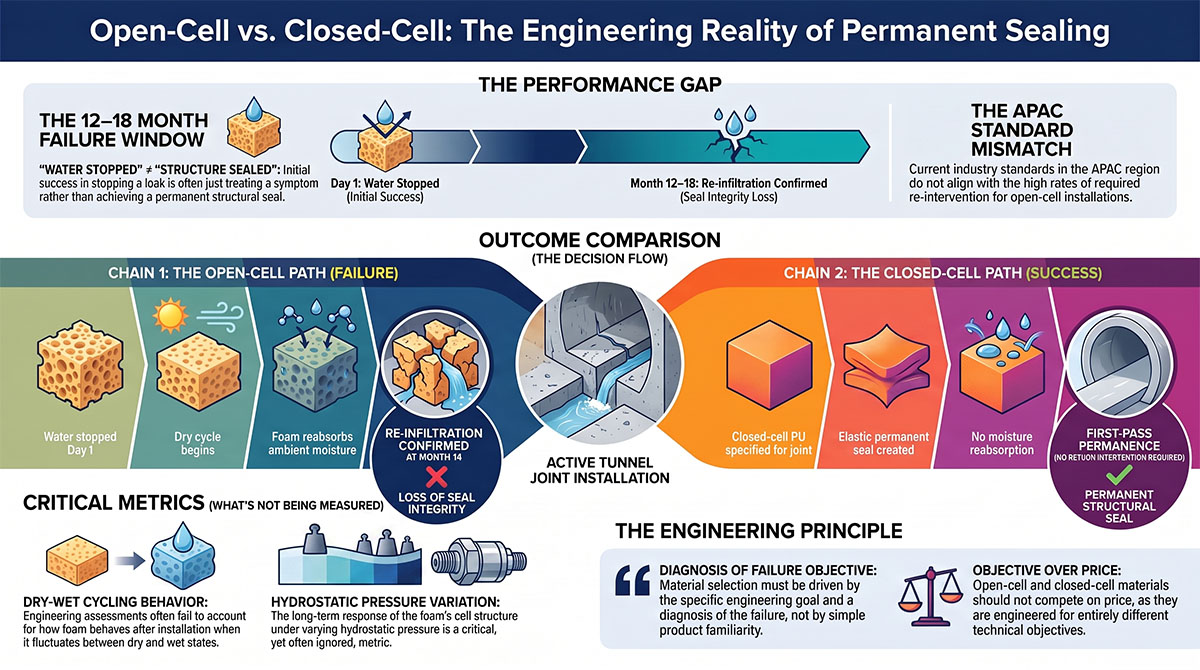
According to technical data, the current industry standards—specifically across the APAC region—contain a massive blind spot. There are three critical data points currently missing from the standard evaluation of a successful repair:
- Dry-wet cycling behavior: How the foam reacts after installation when the water table fluctuates.
- Long-term cell structure response: How the material behaves under continuous hydrostatic pressure variation.
- The “Stop vs. Seal” distinction: Explicit verification of whether the water path is truly eliminated or merely obstructed.
As the engineering principle dictates:
“When the water stopped on day one — did you know if the structure was sealed, or just the symptom?”
The 14-Month Re-infiltration Trap
The most alarming trend in underground asset maintenance is the 12-to-18-month failure window. This is the “Re-infiltration Trap.” It occurs most frequently in active tunnel joints where open-cell polyurethane (PU) foam is specified for permanent sealing.
The failure here is uniquely insidious because it is often the result of the “correct execution of the wrong objective.” A contractor can perform a technically perfect injection using an open-cell product, and because it stops the water on day one, it appears to be quality work. However, because the objective—permanent sealing—was fundamentally mismatched with the material’s capabilities, the project is essentially a countdown to a second mobilisation.
Chain 1: The Open-Cell Path reveals a predictable and costly trajectory. By month 14, the initial success evaporates, re-infiltration is confirmed, and the asset owner is forced into a second mobilization. This is not a maintenance cycle; it is a failure of initial strategy.
The Hidden Danger of the “Dry Cycle”
To understand why repairs fail, we must look at the technical failure mechanism during the “dry cycle.” When an active tunnel joint undergoes a period without water, the material is exposed to ambient conditions.
- Chain 1 (The Open-Cell Path): In this scenario, the open-cell foam acts as a wicking mechanism. During dry periods, the material reabsorbs ambient moisture, leading to a total loss of seal integrity. It is the antithesis of a permanent barrier; it is a porous sponge that eventually invites water back into the structure.
- Chain 2 (The Closed-Cell Path): This path utilizes material engineered for “first-pass permanence.” A closed-cell PU provides an elastic permanent seal that allows for zero moisture reabsorption.
While the open-cell path leads to confirmed re-infiltration and the operational headache of returning to the site, the closed-cell path maintains structural integrity regardless of moisture fluctuations.
Selection is a Diagnosis, Not a Price Comparison
A major strategic disconnect exists in infrastructure procurement: materials are often selected based on price or product familiarity rather than a “diagnosis of the failure objective.”
The fact that APAC standards and re-intervention rates don’t match is a clear signal that our selection criteria are broken. Open-cell and closed-cell materials do not compete on price—they are entirely different tools. One is a temporary flow-stopper; the other is a structural sealant.
Choosing a material because it is familiar or cheaper on day one is a failure of diagnosis. If the objective is to seal an active tunnel joint permanently, specifying an open-cell material is an engineering error, regardless of how well it is injected. We must stop measuring the cost of the material and start measuring the cost of the 14-month failure.
Beyond the Quick Fix
Infrastructure engineering must move beyond the “quick fix” mentality of day one. True success is not a dry joint during the handover; it is a dry joint at month 14 and beyond. By shifting our focus from merely “stopping water” to achieving “first-pass permanence,” we can eliminate the cycle of re-intervention.
As you evaluate your next project, ask the hard question: Is your current standard for success designed to protect the asset for its lifetime, or are you simply subsidizing a second mobilization eighteen months from now?